

Restoring the Tide: Connecting Salt Marsh Science and Resilient Design

Ashley Teitelman and Daniel Miller presented with The Trustees about Greenwood Farms at the MassFm Conference in Worcester, MA
Adapted from a presentation by Ashley Teitelman, PE and Dan Miller, PhD
Salt marshes provide critical habitat, absorb wave energy, and retain sediment that reduce coastal erosion. Their ability to sustain these functions depends on how water moves through the landscape. Historic causeways, ditches, and other barriers can disrupt tidal exchange, trapping water and affecting marsh health. At Greenwood Farm in Ipswich, MA, part of the Great Marsh, New England’s largest salt marsh ecosystem, an ongoing restoration project demonstrates how field investigations and hydraulic modeling can inform restoration while accounting for rising sea levels.
Working with The Trustees of Reservations, Tighe & Bond is developing a design to address restrictions caused by two partially breached former causeways across Greenwood Creek. Water level monitoring documented an approximate 4.5-foot difference between upstream and downstream water levels at low tide, revealing the extent of the drainage restriction. This restriction has negative impacts on upstream salt marsh health and can limit long-term resilience and ecosystem health.
-
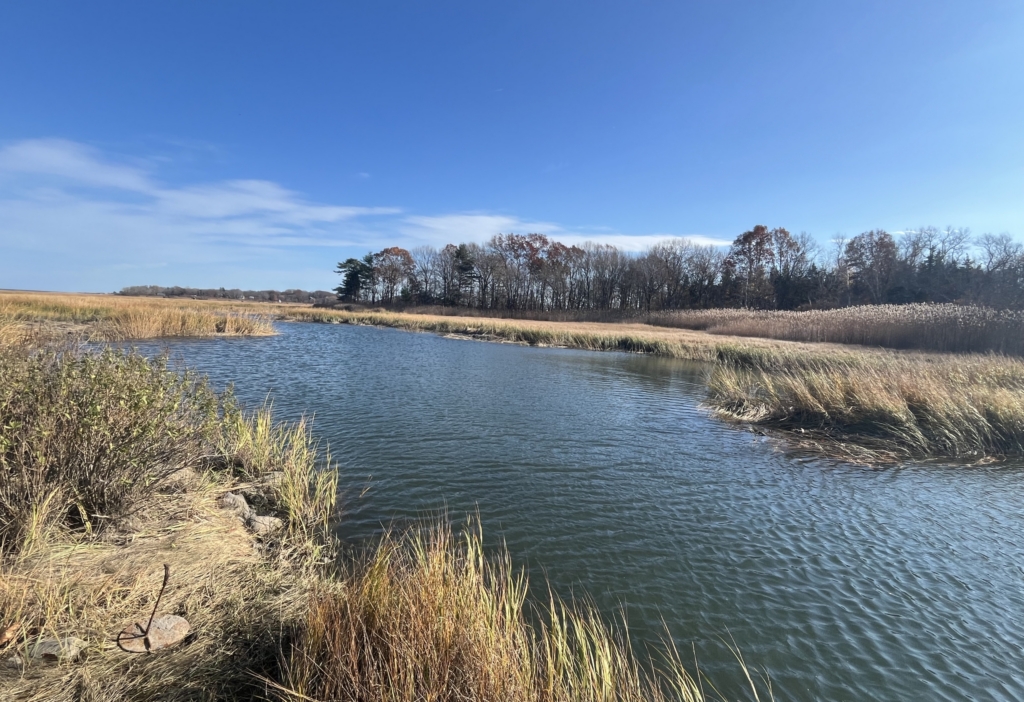
- High tide
-
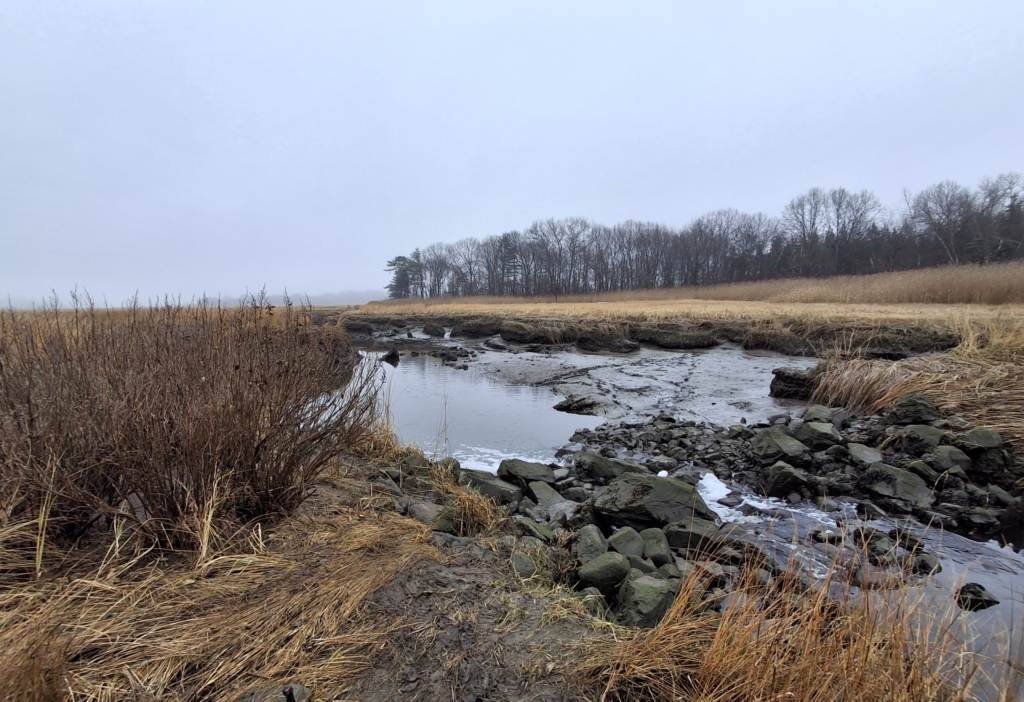
- Low tide
The team developed a two-dimensional hydraulic model calibrated to measured water levels, comparing existing conditions with barrier removal alternatives under typical tides and sea level rise scenarios for 2050 and 2070. The alternatives revealed a practical tradeoff: greater tidal connectivity required substantially more sediment removal.
“Restoring a more natural tidal cycle can improve habitat conditions for salt marsh vegetation and wildlife,” said Dan Miller, Principal Environmental Scientist. “At Greenwood Farm, careful sediment management and protection of existing wetlands are integral to achieving those ecological benefits while limiting disturbance to the resources we’re working to restore.”
“Our modeling shows how removing the tidal restrictions could improve drainage and reduce water trapped upstream at low tide,” said Ashley Teitelman, Project Engineer. “Evaluating these improvements under future sea level scenarios allows us to design for both current conditions and the marsh’s long-term resilience.”
Translating these findings into a workable design requires balancing habitat protection, historic resources, construction access, and cost. As the project advances through design and permitting, Greenwood Farm illustrates the value of integrating ecological assessments, monitoring, and modeling early. Together, these disciplines allow project teams to evaluate tradeoffs before construction and develop restoration approaches grounded in each site’s conditions and long-term resilience goals.